
For generations, legume biologists have investigated the gene regulatory networks governing symbiotic nitrogen fixation, nutrient allocation, and plant architecture. Yet, lacking precise 3D spatial coordinates, our understanding of soybean organogenesis remains fragmented. Traditional bulk sequencing liquidates tissue, wiping out the microenvironments where cells reside and erasing critical anatomical data (Hu et al., 2026). To break yield ceilings and secure global protein and oil supplies amid climate volatility, we must directly observe dynamic gene expression within the intricate, microscopic cellular architecture where soybean biology happens.
Why Soybean Spatial Heterogeneity Holds the Key to Global Protein Security
Soybean (Glycine max) serves as a global agricultural cornerstone and a classic model for nitrogen-fixing legumes. Unlike cereal crops dependent on synthetic nitrogen fertilizers, soybeans possess a unique biological capacity: executing a precise genetic dialogue with soil rhizobia to develop an entirely new, specialized organ from scratch—the root nodule. This micro-factory directly converts inert atmospheric nitrogen into bioavailable ammonium.
However, nodule organogenesis demands massive metabolic energy, strict cellular restructuring, and physical root-to-nodule vascular connectivity. Throughout this lifecycle, major developmental milestones—from the differentiation of stem cell niches in the shoot apex to leaf morphogenesis and nodule compartmentalization—are orchestrated by highly precise, spatially restricted gene regulatory programs.
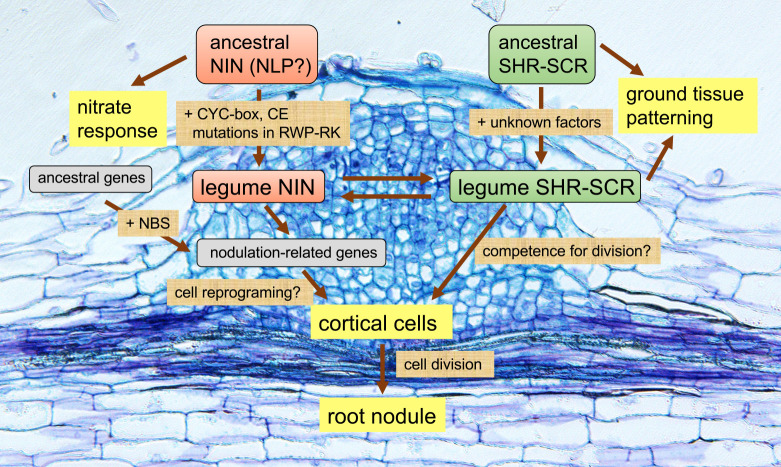
Figure 1. Evolutionary Model of Legume Nodulation. How the NIN network and SHR-SCR module promote cortical cell division. Background: Lotus japonicus primordium, providing a conserved evolutionary framework for soybean development (Suzaki, 2023).
Critical Microenvironments and Spatial Heterogeneity in Soybean
Optimizing nitrogen fixation and biomass requires deciphering spatial heterogeneity at micron or nanoscale levels across several paramount microenvironments:
The Root Tip Patterning Zone: The stem cell niche within the root apical meristem (RAM) dictates root elongation and cortical differentiation, serving as the physical "first contact interface" for symbiotic signaling.
The Root–Nodule Vascular Junction Area: This structural hub connects the main root to the emerging nodule. Cells here undergo massive transcriptomic reprogramming to forge specialized vascular channels for carbon-for-nitrogen exchange.
The Hypoxic Symbiotic Center: Because the nitrogenase enzyme is extremely oxygen-sensitive, the nodule interior must establish a strict oxygen barrier, forcing cells to pivot toward low-oxygen regulation and glycolytic pathways.
The Shoot Apical Meristem (SAM): The master control center determining growth habits (determinate vs. indeterminate architecture). Cellular shifts of just a few micrometers among meristematic layers (L1, L2, L3) dictate leaf primordia fate and floral transitions.
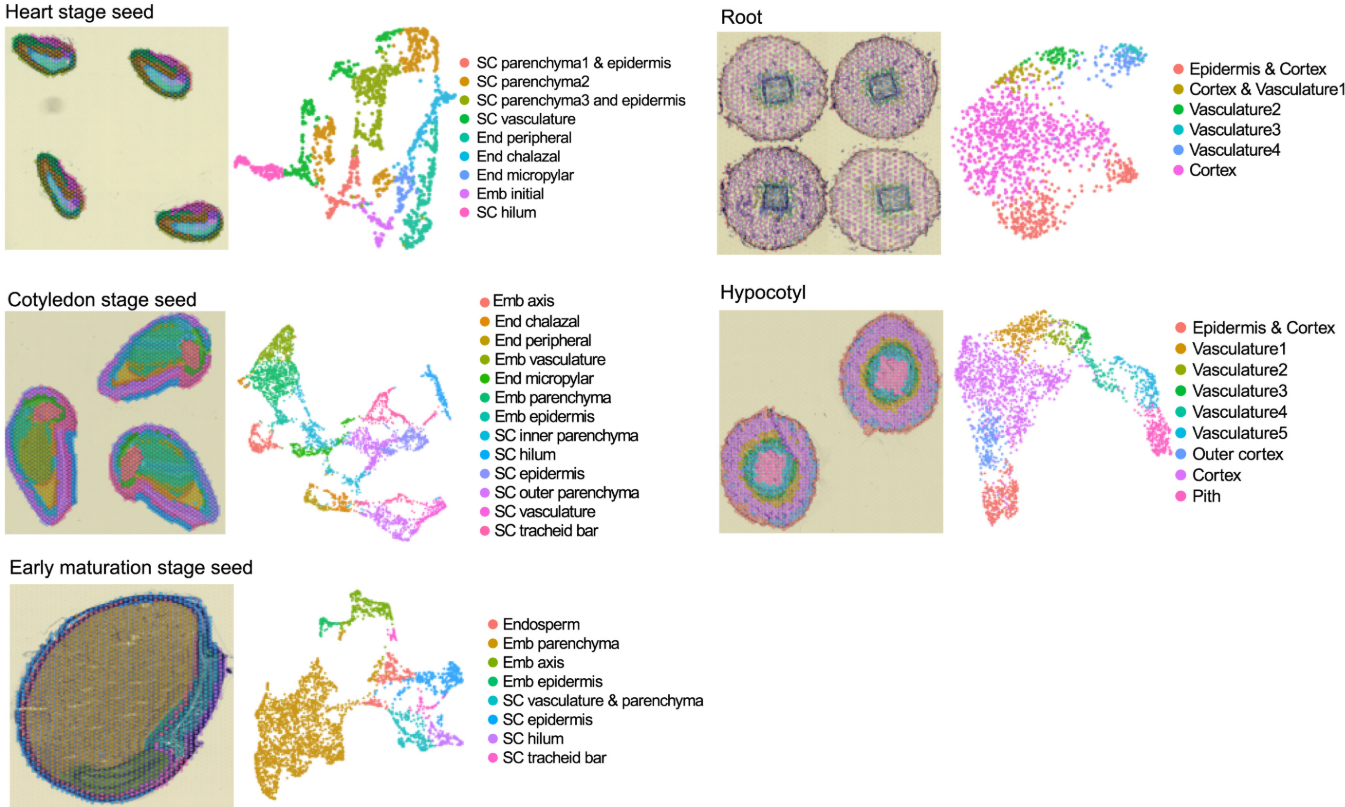
Figure 2. High-resolution Stereo-seq spatial spot clustering mapped directly onto soybean tissue sections (left) and corresponding UMAP projections (right), detailing distinct cellular microenvironments across heart stage seed, root, cotyledon, and hypocotyl (Zhang et al., 2024).
Because these anatomical structures are exceptionally compact and continuously evolving, the core transcription factors driving soybean development (such as the HD-ZIP family) exhibit highly restricted spatial expression patterns. Capturing full transcriptomic landscapes across these microscopic spatial gradients is an absolute prerequisite to unlocking the inner mechanics of soybean development.
The Molecular Blindspots of Homogenized Genomics in Soybean Research
Dense cellulosic cell walls, high concentrations of secondary metabolites (such as soy isoflavones and tannins), and extreme cellular heterogeneity pose significant challenges for traditional genomic tools profiling soybean tissues:
Bulk RNA-seq: Grinding up an entire soybean nodule or shoot apex delivers reliable quantitative metrics, but it outputs a flattened average of thousands of distinct cell types. If a vital sugar transporter is activated exclusively within the single layer of cells lining the nodule vascular bundle while remaining dormant in surrounding cortical tissues, bulk RNA-seq will completely wash away this vital mechanism.
Single-Cell RNA-seq: Although snRNA-seq has successfully identified many uncharacterized cellular subtypes in soybeans, the mechanical or enzymatic isolation of nuclei completely strips away their primary 3D physical coordinates, forcing researchers to rely on computational estimations rather than direct anatomical observation. Researchers are left with a detailed "parts list" of soybean cells but miss the "assembly manual" showing how they nest together in space.
Traditional tools simply cannot answer a foundational biological question: On exactly which side of the cellular layer within the root nodule did this core nitrogen-fixing regulatory gene undergo targeted up-regulation?
Stereo-seq: Illuminating Soybean Molecular Anatomy at Subcellular Resolution
STOmics' Stereo-seq provides a transformative solution to overcome these bottlenecks in soybean research by seamlessly balancing sub-micron resolution with an expansive field of view (Liu et al., 2023):
Nanoscale Spatial Resolution (500 nm): Leveraging DNA Nanoball (DNB) patterned array technology, Stereo-seq features a center-to-center spot distance of 500 nm. This allows researchers to effectively permeabilize rigid plant cell walls, tracking molecular gradients of soybean transcripts at single-cell or subcellular resolution, clearly delineating vascular margins that are only one or two cell layers thick.
Centimeter-Scale Field of View (Up to 13 × 13 cm): This extensive capture area allows scientists to lay continuous longitudinal soybean roots, complete stem cross-sections, or multiple root nodules at various developmental stages onto a single chip. It completely eliminates experimental batch effects and provides a truly continuous, large-scale spatial landscape of intact soybean organs.
High Compatibility with Complex Plant Matrices (FF & FFPE): To address the high polyphenol/polysaccharide content and prone-to-degrade nature of soybean RNA, Stereo-seq offers high-sensitivity Fresh Frozen (FF) workflows. Additionally, our Stereo-seq OMNI solution is specifically optimized for formalin-fixed paraffin-embedded (FFPE) blocks, ensuring high-quality spatial transcriptome recovery even from stubborn archival plant tissues with low RIN values.
Previewing the Frontier: Join the Spatiotemporal Legume Webinar
This blog post frames the core biological principles; our upcoming webinar is where you will see these spatial soybean datasets come to life.
On Thursday, June 18, 2026, at 09:00 AM Beijing/Singapore Time (11:00 AM AEST / 10:00 AM JST), Dr. Chuan Chen, lead research scientist from BGI Research and co-first author of the Molecular Plant publication, will deliver an exclusive presentation. He will deep-dive into how the team leveraged Stereo-seq to conquer challenging polyphenol-rich plant tissues, present interactive 3D panoramic transcriptomic digital maps of core soybean organs, and explain how to harness spatial coordinates to uncover key regulatory targets that influence nitrogen fixation and plant architecture.
If you are exploring ways to implement spatial multi-omics workflows into your soybean, legume, or broader plant-microbe symbiosis research programs, do not miss this premier data showcase.
📅 Date: Thursday, June 18, 2026
⏰ Time: 09:00 AM Beijing / Singapore Time (10:00 AM JST/KST | 11:00 AM AEST)
💻 Format: Zoom Webinar — Presentation + Q&A
📖 Featured Literature: Molecular Plant
👉 Click Here to Reserve Your Complimentary Seat Now!
References