
We know which genes dictate yield; we just cannot see where they activate inside the developing spike. For decades, the lack of precise spatial coordinates has left our understanding of plant morphogenesis fundamentally fragmented (Millsteed et al., 2025).
Why Inflorescence Morphogenesis Holds the Key to Food Security
Wheat (Triticum aestivum) provides roughly one-fifth of global dietary calories and protein, making yield maximization an urgent security imperative under escalating climate volatility (Zhang et al., 2026).
Crucially, the final grain number on each plant is not determined at harvest time. It is locked in weeks earlier during a highly compressed developmental window inside a structure so small it can barely be seen with the naked eye: the developing inflorescence, or spike.
During these critical early weeks of a life cycle, the plant’s shoot apical meristem (SAM) transitions from vegetative growth to reproductive development. The precise spatial arrangement and timing of gene expression during this transition dictate the ultimate yield ceiling. Getting these developmental stages right allows the plant to unlock larger, more resilient harvests; getting them wrong results in fewer grains per spike—a reproductive loss multiplied across fields globally every single season.
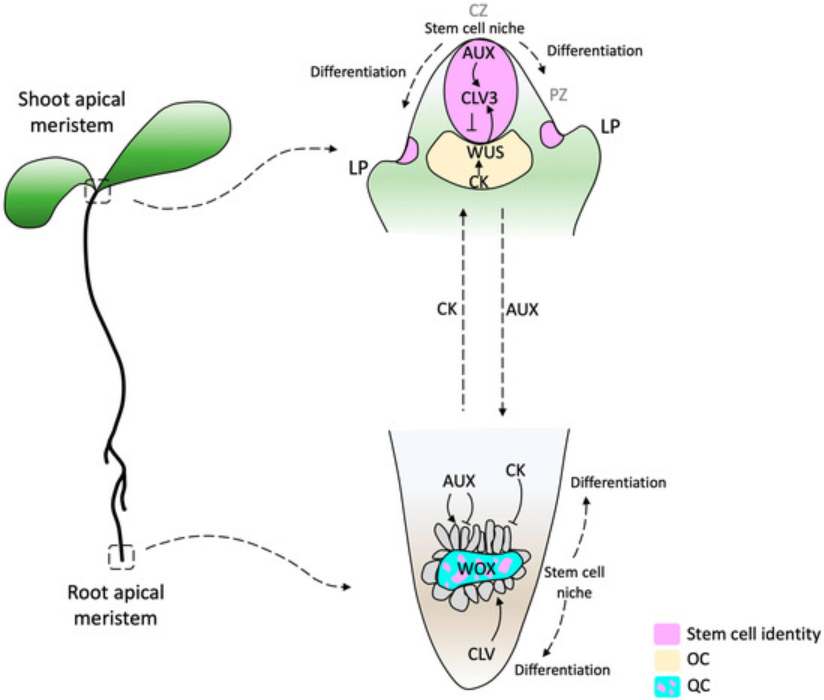
Figure 1. Schematic showing stem cell organization in the shoot apical meristem (SAM) and root apical meristem (RAM), highlighting key regulatory domains, transcription factors, and auxin/cytokinin signaling that coordinate stem cell maintenance and differentiation (Kean-Galeno et al., 2024).
The Spatial Heterogeneity of the Spike
To effectively manipulate yield, researchers must map the highly compact, heterogeneous anatomy of the young wheat inflorescence across four decisive transitional phases (Kean-Galeno et al., 2024):
Double-Ridge (DR) Stage: The transitioning shoot apex elongates and bifurcates into distinct bract ridges and axillary spikelet meristems (SM), establishing the basal capacity for total spikelet number per spike.
Floret Meristem (FM) Stage: Occurring roughly one week post-DR, spikelet meristems sequentially initiate glume (GP) and lemma primordia (LP) to establish a tiered series of 6 to 8 floret meristems (FMs). Sharp spatial polarity gradients control floret initiation.
Anther Primordia (AM) Stage: Governs organ differentiation and ultimate floret fertility. Stamen (STP) and pistil primordia (PP) visibly emerge from the FMs, driven by highly localized gene networks.
Terminal Spikelet (TS) Stage: Marks the critical developmental turning point where the shoot apical meristem (SAM) ceases the initiation of new spikelet primordia. This definitive stage locks in the ultimate spikelet number per spike, directly establishing the absolute ceiling for the plant's yield potential.
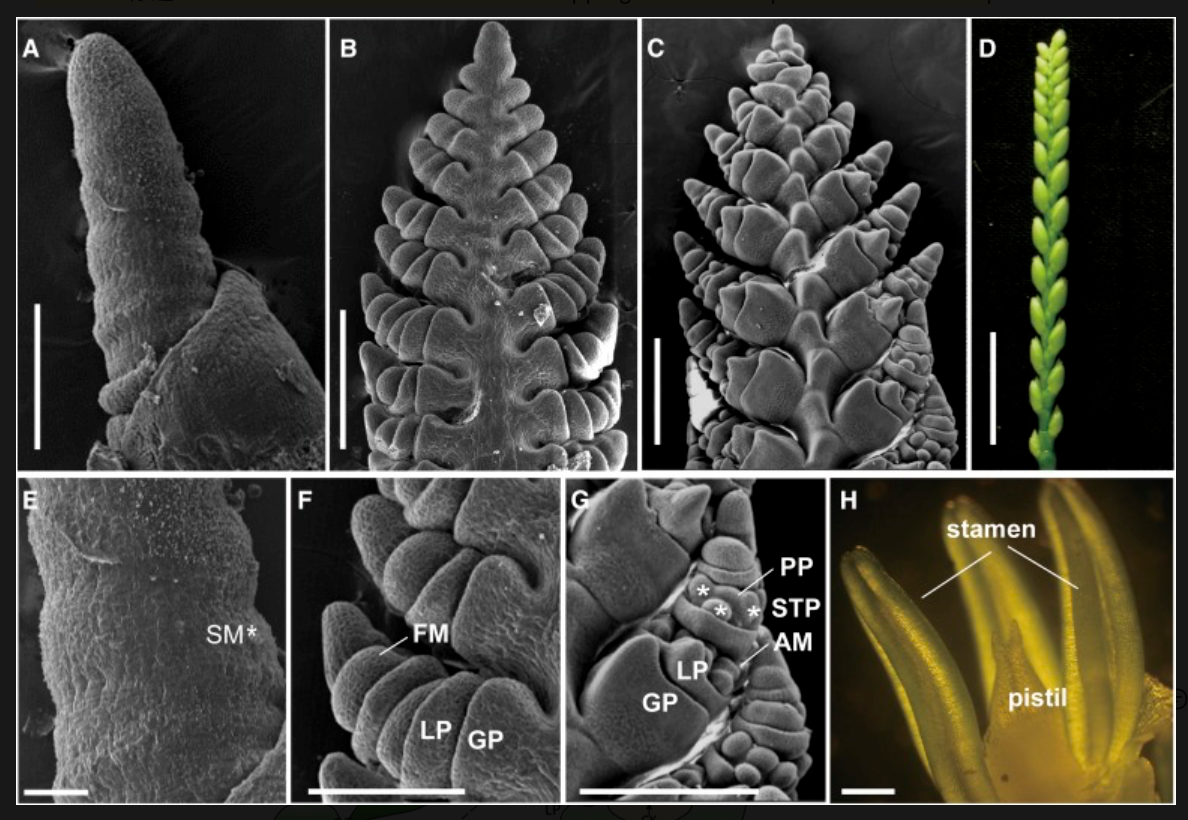
Figure 2. Key developmental stages of early wheat inflorescence. Representative images showing wheat inflorescence development from double ridge (DR) and floret meristem (FM) to anther meristem (AM) and terminal spikelet (TS), highlighting the sequential formation of spikelet, floral, and reproductive primordia. Insets show magnified views of each stage (Feng et al., 2017).
Because these developmental windows are incredibly narrow and the physical structures are highly compact, the master regulatory genes controlling them (such as the MADS-box transcription factor family and flowering locus homoeologs) exhibit highly localized expression patterns. Capturing the full transcriptomic landscape across these microscopic spatial gradients is essential to understanding the true molecular mechanics of development.
The Core Scientific Challenge: The extreme cellular heterogeneity and minute physical scale of early wheat spikes demand a genomic tool that simultaneously delivers whole-transcriptome coverage and subcellular spatial resolution. Missing the spatial context means misinterpreting the developmental mechanism.
The Blind Spots of Traditional Omics: Resolving "Spatial Distortion"
For years, plant genomics has relied on high-throughput sequencing tools that inherently compromise on spatial context, leaving fundamental questions unanswered.
Bulk RNA-seq: Traditional bulk transcriptomics requires grinding up the entire inflorescence or large dissected tissue sections. While it provides an excellent quantitative profile of gene expression, it yields a blended average of thousands of heterogeneous cells. In a developing wheat spike, where a gene might act as an activator in the apical meristem but a repressor in the basal spikelet, Bulk RNA-seq completely masks these critical microenvironmental nuances.
Single-Cell RNA-seq: While single-cell RNA-seq (scRNA-seq) has revolutionized cell-type identification, its application in plant biology encounters severe bottlenecks. Isolating single cells requires enzymatic cell wall digestion to generate protoplasts. This aggressive dissociation process strips away the exact feature that drives plant development: the physical, three-dimensional spatial context. Furthermore, the protoplasting process itself is notorious for inducing artificial, mechanical stress-response genes, which can distort true biological data.
Neither tool can answer the definitive question: Is this yield-enhancing gene active in the crucial cell layer of the spikelet primordia, or is it idling in the surrounding structural tissue?
Stereo-seq: Illuminating Plant Morphogenesis at Subcellular Resolution
Stereo-seq provides a transformative solution to these limitations, offering unprecedented resolution and scale for mapping complex plant microenvironments:
Nanoscale Resolution (500 nm): Utilizing DNA nanoball (DNB) technology with a 500 nm center-to-center pitch, Stereo-seq achieves genuine subcellular precision. It maps molecular gradients that traditional micron-scale platforms blur, pinpointing the exact coordinates of MADS-box transcription factors and flowering locus homoeologs within compact spikelet layers.
Centimeter-Scale Field of View (Up to 13 × 13 cm): Large chip designs allow the capture of macro-scale, intact plant sections. PIs can array wild-types, genetic knockouts, and all four sequential developmental stages on a single slide—fundamentally eliminating experimental batch effects, optimizing sequencing costs, and streamlining workflows (generating purified cDNA in just 1 day).
Broad Plant Compatibility (FF & FFPE): Overcomes the specific challenges of robust plant cell walls and secondary metabolites that frequently compromise RNA integrity. Stereo-seq offers high-yield Fresh Frozen (FF) workflows alongside the Stereo-seq OMNI solution for FFPE—recovering highly sensitive spatial data even from low-RIN or degraded archival wax blocks.
Paving the Way for Spatial Multi-Omics: While currently revolutionizing whole-transcriptome spatial mapping, the STOmics platform is actively driving the future of plant biology toward multi-omic integration. Future applications, such as adapting Stereo-CITE for complex plant tissues, hold the potential to simultaneously capture RNA and multiplexed protein expression. This evolving multi-dimensional mapping will eventually provide the in situ verification needed to resolve RNA-protein expression discordances within nascent floral primordia.
Mapping the Wheat Inflorescence: Unlocking Grain Yield Potential
Leveraging the high-resolution capabilities of Stereo-seq spatial transcriptomics, a research team from Adelaide University, in collaboration with Yazhouwan National Laboratory and BGI Research, has successfully mapped the high-resolution spatial transcriptomic landscape of the developing wheat inflorescence.
By profiling multi-ovary (MO) and near-isogenic single-ovary (SO) wheat lines at the decisive lemma primordium (LP) stage, the study delineates the exact spatial coordinates of cell populations and gene networks governing floral meristem maintenance. This research provides a definitive spatial framework for understanding how elevated WUS-D1 gene activity prolongs floral meristem competence and delays termination. By resolving these micro-scale regulatory programs, the study offers a precise developmental roadmap to engineer accessory ovaries and bypass traditional yield ceilings to increase grain number per spikelet.
Previewing the Frontier: Join Us on June 18
This article outlines the science. The webinar is where you see it firsthand.
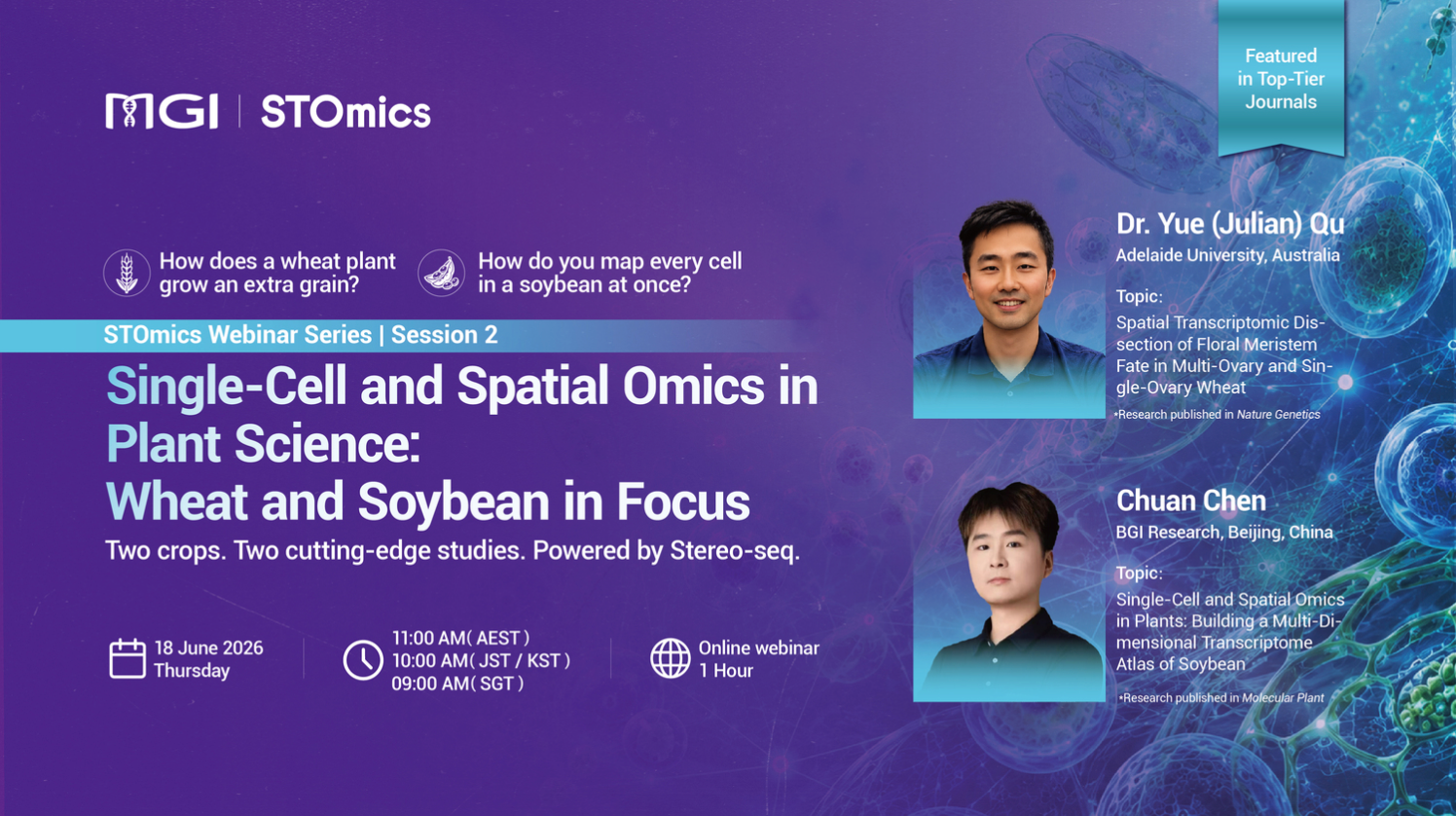
On June 18, lead researcher Dr. Yue (Julian) Qu from Adelaide University (Australia) will present these cutting-edge spatial maps of the wheat inflorescence—walking through how Stereo-seq was used to resolve cell-type-specific regulatory changes and distinct spatial domains across highly compact spikelet primordia (Tao et al., 2026). This session offers an exclusive deep dive into how sub-micron spatial biology translates directly into agricultural innovation.
📅 Date: Thursday, June 18, 2026
⏰ Time: 11:00 AM AEST (10:00 AM JST/KST | 09:00 AM SGT)
💻 Format: Zoom Webinar — Live presentations + Q&A
📖 Published in: Nature Genetics
References